Best Employee Survey Software 2026
A comprehensive comparison of the leading employee survey platforms to help you measure engagement, gather feedback, and drive meaningful workplace improvements.
Watch: Employee Survey Software Guide
Comparison Criteria
Pricing
$ = Budget (Under $5/user/mo)
$$ = Mid-range ($5-15/user/mo)
$$$ = Premium ($15-25/user/mo)
$$$$ = Enterprise (Custom pricing)
User Rating
Based on verified reviews across G2, Capterra, and TrustRadius platforms. Rating out of 5.
Usability
Ease of use rating based on user interface intuitiveness, onboarding experience, and admin complexity.
Company Size
The ideal organization size where the solution performs best based on features, scalability, and pricing.
1. Culture Amp
- Engagement surveys
- Pulse surveys
- 360° feedback
- Benchmarking data
- Action planning tools
- Higher pricing tier
- Complex for small teams
- Advanced analytics can be overwhelming
- Requires HR support for rollout
2. Qualtrics EmployeeXM
- Employee lifecycle surveys
- Predictive analytics
- Text analytics with AI
- 360° assessments
- Real-time dashboards
- Significant cost investment
- Complex implementation
- Steep learning curve
- Requires dedicated admin
3. Lattice
- Engagement surveys
- eNPS tracking
- Pulse surveys
- Performance integration
- Manager action plans
- Survey module is an add-on
- Less sophisticated than dedicated survey tools
- Limited benchmarking data
- Price increases with modules
4. SurveyMonkey (Momentive)
- Pre-built HR survey templates
- Custom survey builder
- Anonymous responses
- Basic analytics
- Integration with HR tools
- Not HR-specific by design
- Limited action planning
- Basic engagement benchmarks
- Advanced features cost extra
5. 15Five
- Engagement surveys
- Pulse check-ins
- Weekly reports
- Manager effectiveness survey
- Performance integration
- Limited enterprise reporting
- Survey tool is part of broader platform
- Fewer question types than dedicated tools
- Basic benchmarking
6. Leapsome
- Engagement surveys with AI insights
- Pulse surveys
- eNPS
- Benchmarking
- Action planning with AI suggestions
- Smaller market presence
- Limited third-party integrations
- Some features in higher tiers
- Newer benchmarking dataset
7. Officevibe (Workleap)
- Automated pulse surveys
- Anonymous feedback
- Manager dashboard
- Recognition tools
- eNPS tracking
- Limited customization
- Basic reporting compared to enterprise tools
- Fewer survey types
- Limited integration options
8. Peakon (Workday)
- Continuous listening platform
- AI-driven insights
- Natural language processing for comments
- Industry benchmarking
- Driver analysis
- Enterprise pricing
- Complex setup
- Part of Workday ecosystem
- Less flexible for standalone use
9. TINYpulse (Limeade)
- Anonymous pulse surveys
- Recognition and cheers
- Suggestion box
- Manager coaching tips
- Simple analytics
- Limited advanced analytics
- Basic reporting
- Fewer enterprise features
- Smaller development roadmap
10. Glint (LinkedIn)
- Employee engagement surveys
- AI-powered narrative intelligence
- Manager effectiveness
- Org health analytics
- LinkedIn integration
- Enterprise pricing only
- Complex implementation
- Requires LinkedIn ecosystem
- Limited standalone availability
How to Select the Right Employee Survey Software
Define Your Listening Strategy
Before evaluating survey platforms, clarify what you want to measure and how often. Are you looking for annual comprehensive engagement surveys, frequent pulse checks, lifecycle surveys (onboarding, exit), or a combination? Different platforms excel at different survey types. A clear listening strategy helps you choose a tool that aligns with your feedback culture and organizational cadence.
Evaluate Analytics and AI Capabilities
The real value of employee survey software lies in its ability to turn raw data into actionable insights. Look for platforms that offer AI-powered text analysis for open-ended responses, driver analysis to identify what most impacts engagement, predictive analytics to spot at-risk teams, and benchmarking against industry data. These capabilities transform surveys from data collection exercises into strategic decision-making tools.
Prioritize Anonymity and Trust
Employee surveys only deliver value when employees feel safe providing honest feedback. Evaluate how each platform handles anonymity — including minimum response thresholds for reporting, comment attribution controls, and transparent privacy policies. The best platforms make their confidentiality guarantees clear to employees, which directly impacts response rates and the quality of feedback you receive.
Assess Action Planning Features
Collecting feedback without acting on it can be worse than not surveying at all. The best survey platforms include built-in action planning tools that help managers translate survey results into concrete improvements. Look for features like suggested actions based on results, goal tracking for improvement initiatives, manager nudges, and the ability to close the feedback loop by communicating changes back to employees.
Consider Integration and Scalability
Your survey tool should integrate with your existing HR tech stack — HRIS, performance management, communication tools like Slack or Teams, and business intelligence platforms. Consider whether you need a standalone survey tool or a platform that combines surveys with performance management and other people operations. Also evaluate whether the platform can scale with your organization as you grow in headcount, geographic reach, and survey complexity.
Current Trends in Employee Survey Technology
AI-Powered Sentiment Analysis
Artificial intelligence is revolutionizing how organizations interpret survey data. Modern platforms use natural language processing to analyze open-ended comments at scale, detecting themes, sentiment shifts, and emerging concerns that would be impossible to identify manually. AI-driven narrative intelligence helps HR teams understand the "why" behind engagement scores and prioritize the most impactful actions.
Continuous Listening Platforms
The shift from annual surveys to continuous listening is accelerating. Organizations are adopting always-on feedback channels that combine scheduled pulse surveys, event-triggered lifecycle surveys, and on-demand feedback tools. This approach provides a real-time view of employee sentiment, enabling faster response to emerging issues and creating a culture where feedback flows naturally in both directions.
Manager Empowerment Tools
Leading survey platforms are shifting from centralized HR reporting to manager-level dashboards and coaching tools. Managers receive team-specific insights, suggested conversation starters, and action plan templates that empower them to address feedback at the team level. This decentralization of survey ownership drives faster action and makes feedback more relevant to day-to-day work experiences.
Predictive Employee Analytics
Advanced survey platforms now go beyond reporting what happened to predicting what will happen next. By combining survey data with other signals like turnover patterns, performance data, and market benchmarks, these platforms can forecast flight risk, identify teams approaching burnout, and quantify the business impact of engagement improvements — turning employee surveys into a strategic workforce planning tool.
DEI-Focused Survey Design
Organizations are increasingly using surveys to measure diversity, equity, and inclusion outcomes. Modern platforms offer DEI-specific question banks, demographic segmentation with privacy safeguards, and benchmarking data that helps companies understand how different employee groups experience the workplace. These insights enable targeted interventions to build more inclusive cultures.
Integration with Employee Experience
Survey tools are converging with broader employee experience platforms that connect feedback data with performance, learning, recognition, and wellbeing data. This holistic view enables organizations to understand the full employee journey and identify the moments that matter most for engagement, retention, and productivity — moving beyond isolated survey scores to comprehensive people analytics.
Frequently Asked Questions
What is employee survey software?
Employee survey software is a platform that helps organizations collect, analyze, and act on employee feedback through structured surveys such as engagement surveys, pulse surveys, eNPS (Employee Net Promoter Score), and lifecycle surveys. These tools enable HR teams to measure employee sentiment, identify workplace issues, track engagement trends over time, and drive data-backed improvements to company culture and employee experience.
How often should you run employee engagement surveys?
Most HR experts recommend running a comprehensive engagement survey once or twice per year, supplemented by shorter pulse surveys every 1-4 weeks. Annual surveys provide deep insights into engagement drivers, while frequent pulse surveys help you track trends and respond quickly to emerging issues. The ideal cadence depends on your organization's size, rate of change, and capacity to act on results. Avoid survey fatigue by keeping pulse surveys short (5-10 questions) and always communicating what actions you're taking based on feedback.
What is the difference between an engagement survey and a pulse survey?
An engagement survey is a comprehensive questionnaire (typically 40-80 questions) administered annually or biannually that measures overall employee engagement, satisfaction, and alignment with company values. A pulse survey is a shorter, more frequent check-in (5-15 questions) conducted weekly, biweekly, or monthly that tracks specific engagement metrics over time. Engagement surveys provide a broad snapshot, while pulse surveys offer real-time trend data and allow organizations to respond quickly to changing employee sentiment.
How much does employee survey software cost?
Employee survey software pricing varies widely based on features and company size. Budget-friendly options like TINYpulse and Officevibe start under $5 per user per month. Mid-range platforms like Lattice, 15Five, and SurveyMonkey typically cost $5-15 per user monthly. Premium solutions like Culture Amp charge $15-25 per employee per year. Enterprise platforms like Qualtrics, Peakon, and Glint use custom pricing that can range from $20,000 to over $100,000 annually depending on organization size and feature requirements.
What features should I look for in employee survey software?
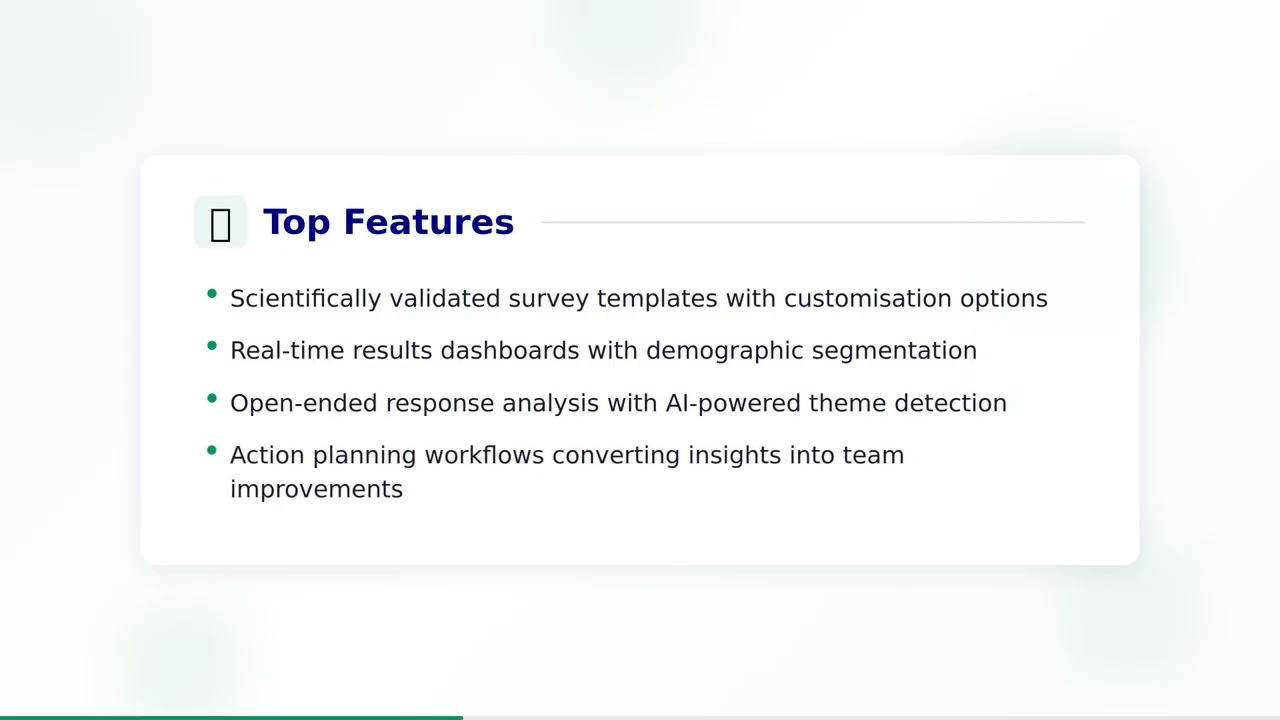
Key features to look for include customizable survey templates, anonymous response options, pulse survey capabilities, eNPS tracking, AI-powered text analytics for open-ended responses, benchmarking against industry data, action planning tools, manager dashboards, mobile accessibility, and integration with your existing HR tech stack. For larger organizations, also consider advanced analytics like predictive insights, heat maps, driver analysis, and natural language processing for comment analysis. The ability to segment results by department, location, and demographics is essential for targeted improvements.
Need Help Selecting the Right Employee Survey Software?
Our HR technology experts can provide personalized recommendations based on your organization's feedback culture, engagement goals, and analytics requirements.