Best ERP Software for HR Teams 2026
A comprehensive comparison of enterprise resource planning platforms with HR capabilities to help you unify finance, operations, and human resources.
Watch: ERP Software Comparison
Comparison Criteria
Pricing
$ = Budget (Under $5/user/mo)
$$ = Mid-range ($5-15/user/mo)
$$$ = Premium ($15-25/user/mo)
$$$$ = Enterprise (Custom pricing)
User Rating
Based on verified reviews across G2, Capterra, and TrustRadius platforms. Rating out of 5.
Usability
Ease of use rating based on user interface intuitiveness, onboarding experience, and admin complexity.
Company Size
The ideal organization size where the solution performs best based on features, scalability, and pricing.
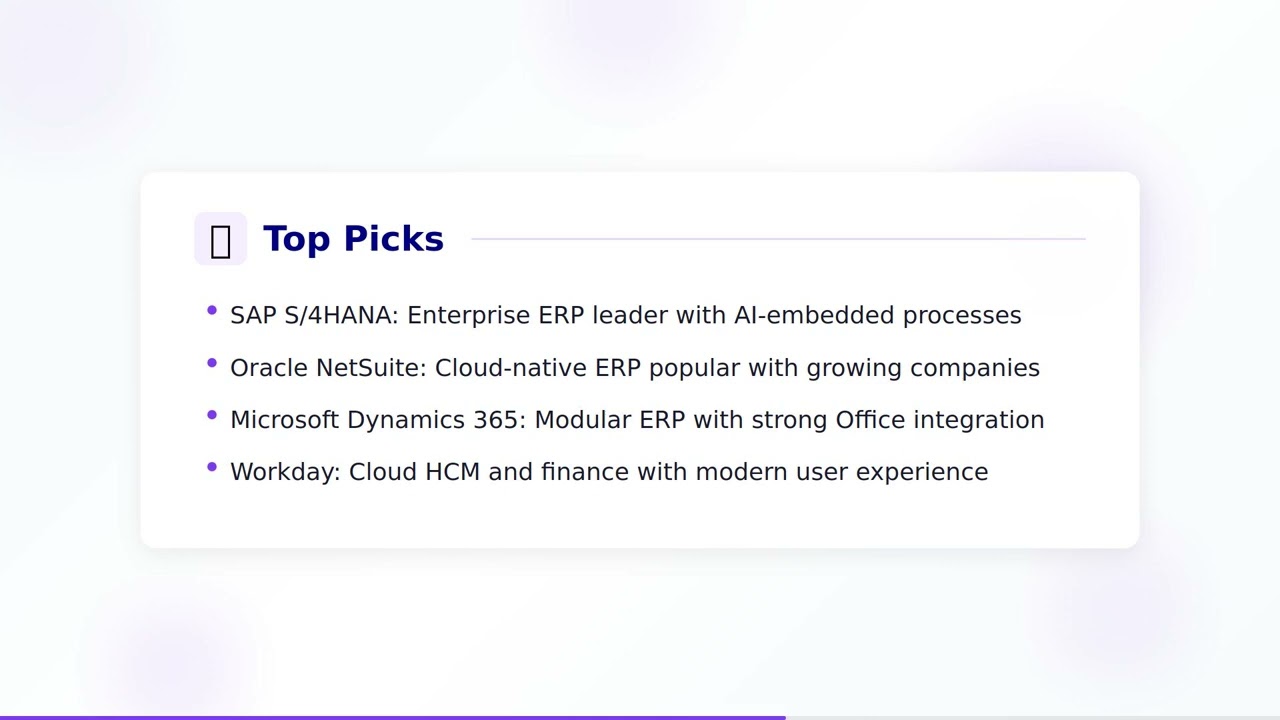
1. SAP S/4HANA
- Integrated ERP and HR
- Real-time analytics
- Global operations
- Supply chain
- Financial management
- Very complex implementation
- Highest cost tier
- Requires SAP expertise
- 12-18 month deployment
2. Oracle NetSuite
- Cloud ERP
- Financial management
- HR module
- CRM
- E-commerce
- HR module is basic vs dedicated HRIS
- Custom pricing
- Implementation costs
- Add-on expenses
3. Microsoft Dynamics 365
- Modular ERP
- HR module
- Financial management
- Supply chain
- Power Platform integration
- HR module less mature than dedicated tools
- Complex licensing
- Implementation effort
- Microsoft ecosystem preferred
4. Workday
- Finance and HR unified
- Planning
- Analytics
- Student/professional services
- Adaptive planning
- Enterprise pricing
- Complex implementation
- HR-centric rather than full ERP
- Limited manufacturing
5. Odoo
- Open-source ERP
- HR modules
- Accounting
- CRM
- Inventory, Manufacturing
- Customization requires development
- Support varies
- Complex at scale
- Community vs Enterprise editions
6. Sage Intacct
- Cloud financial management
- Multi-entity
- Dimensional reporting
- Revenue recognition
- Project accounting
- No built-in HR module
- Finance-focused
- Requires HR integration
- Mid-market pricing
7. Epicor Kinetic
- Manufacturing ERP
- HCM module
- Supply chain
- Production management
- IoT integration
- Manufacturing-focused
- HR module is basic
- Complex implementation
- Niche market
8. Infor CloudSuite
- Industry-specific ERP
- HCM
- Workforce management
- Financial management
- Supply chain
- Complex implementation
- Industry-specific focus
- Premium pricing
- Less flexible than horizontal ERPs
9. Acumatica
- Cloud ERP
- Financial management
- Distribution
- Manufacturing
- Project accounting
- No native HR module
- Requires third-party HR integration
- Growing platform
- Less brand recognition
10. Zoho One
- 45+ integrated apps
- Zoho People HR
- CRM
- Finance
- Project management
- Individual apps less deep than specialists
- Complex with many apps
- Limited enterprise features
- Data migration challenges
How to Select the Right ERP Software for Your HR Team
Define Your Integration Strategy
The most critical decision when selecting ERP software for HR is whether to use the ERP's built-in HR module or integrate with a dedicated HRIS. Built-in HR modules from platforms like Microsoft Dynamics 365, SAP S/4HANA, and Workday offer seamless data flow between HR and finance, but may lack the depth of specialized HR tools. If your organization requires advanced talent management, sophisticated performance reviews, or complex compensation planning, consider pairing a finance-focused ERP like Sage Intacct or Acumatica with a dedicated HR platform.
Assess Your Industry Requirements
Different ERP platforms excel in different industries. Epicor Kinetic is purpose-built for manufacturing with production management and IoT capabilities. Infor CloudSuite offers industry-specific editions for healthcare, hospitality, and distribution. SAP S/4HANA dominates in complex global enterprises. Consider whether you need industry-specific functionality like compliance management, production scheduling, or supply chain optimization alongside your HR needs, and choose a platform that serves both operational and people management requirements.
Evaluate Scalability and Growth Path
Select an ERP that matches your current size but can scale with your growth. Small businesses may start with Zoho One or Odoo for their affordability and flexibility, then migrate to platforms like Oracle NetSuite or Microsoft Dynamics 365 as complexity increases. Acumatica's resource-based pricing (rather than per-user) makes it particularly attractive for growing companies. Consider your 5-year growth plan, potential international expansion, and increasing operational complexity when making your selection.
Consider Total Cost of Ownership
ERP costs extend far beyond subscription fees. Factor in implementation services (often 1-3x annual subscription for mid-market, and 3-5x for enterprise), data migration, customization, training, and ongoing support costs. Open-source options like Odoo have lower licensing costs but may require significant development investment. Cloud-native platforms like Oracle NetSuite and Acumatica reduce infrastructure costs but require ongoing subscription commitments. Build a comprehensive 3-5 year TCO model before making your decision.
Prioritize Data Unification
One of the primary benefits of ERP software for HR teams is unified data across business functions. Evaluate how well each platform connects employee data with financial planning, project management, and operational metrics. Workday excels at unifying HR and finance data, while Microsoft Dynamics 365 offers strong integration with the broader Microsoft ecosystem including Power BI for analytics. Consider how headcount planning, workforce cost analysis, and employee productivity data will flow between HR and finance systems.
Current Trends in ERP Technology for HR
AI-Embedded ERP
ERP vendors are embedding AI throughout their platforms to transform how businesses operate. SAP's Joule AI copilot, Microsoft's Copilot for Dynamics 365, and Oracle's AI agents are automating routine tasks, providing predictive insights, and enabling natural language interactions with business data. For HR teams, this means AI-powered workforce planning, automated expense processing, intelligent reporting, and predictive analytics that connect people data with business outcomes.
Cloud-First Migration
The ERP market is undergoing a massive shift from on-premises to cloud deployment. SAP is migrating customers to S/4HANA Cloud, Oracle has sunset on-premises development, and newer platforms like Acumatica and Zoho One are cloud-native from inception. This transition brings benefits for HR teams including real-time data access, automatic updates, better mobile experiences, and reduced IT overhead. Organizations still on legacy ERP systems face increasing pressure to migrate as vendors reduce on-premises support.
Composable ERP Architecture
Organizations are moving away from monolithic ERP suites toward composable architectures that combine best-of-breed components. This trend benefits HR teams who can select specialized HR tools while maintaining tight integration with ERP financial and operational systems. Open APIs, integration platforms, and low-code tools make it easier to connect disparate systems. Platforms like Odoo and Zoho One support this approach with modular architectures and extensive marketplace ecosystems.
Unified Data and Analytics
Modern ERP platforms are becoming data hubs that unify information across all business functions. For HR teams, this means the ability to correlate workforce data with business performance, analyze labor costs alongside revenue trends, and create comprehensive dashboards that span people and financial metrics. Microsoft's Power Platform integration with Dynamics 365, SAP's analytics cloud, and Workday's Prism Analytics exemplify this trend toward holistic business intelligence.
Industry Cloud Solutions
ERP vendors are increasingly offering industry-specific cloud solutions that combine standard ERP functionality with pre-configured industry processes. Infor leads this trend with CloudSuites for healthcare, manufacturing, and hospitality. For HR teams, industry clouds mean pre-built compliance frameworks, industry-specific workforce management features, and best-practice templates that reduce implementation time and ensure regulatory alignment.
Sustainability and ESG Integration
ERP platforms are adding sustainability and ESG (Environmental, Social, Governance) tracking capabilities. SAP's sustainability solutions, Microsoft's Cloud for Sustainability, and Workday's ESG reporting tools help organizations track and report on their environmental and social impact. For HR teams, this includes DEI metrics, workforce wellbeing data, community impact tracking, and social responsibility reporting — increasingly important for regulatory compliance and employer branding.
Frequently Asked Questions
What is ERP software and how does it relate to HR?
ERP (Enterprise Resource Planning) software is a comprehensive business management platform that integrates core business processes including finance, supply chain, manufacturing, procurement, and human resources into a unified system. For HR teams, ERP software provides a centralized data backbone that connects employee data with financial planning, project management, and operational workflows. Some ERPs like Workday and Microsoft Dynamics 365 include robust HR modules, while others like Sage Intacct focus on finance and require integration with dedicated HR tools.
Should I choose an ERP with a built-in HR module or a separate HRIS?
The decision depends on your organization's complexity and HR needs. A built-in HR module is ideal when you prioritize data integration between HR and finance, want a single vendor relationship, and your HR requirements are standard. A separate HRIS is better when you need advanced HR capabilities like sophisticated talent management, complex compensation planning, or specialized workforce analytics that ERP HR modules typically lack. Many organizations use a hybrid approach — an ERP for finance and operations with a dedicated HRIS for talent management, integrated via APIs. Consider your organization's size, budget, and the depth of HR functionality required.
How much does ERP software cost?
ERP software pricing varies dramatically based on the platform, deployment model, and organization size. Budget options like Zoho One start at $35-45 per user per month, and Odoo offers a free community edition with paid enterprise plans starting around $25 per user per month. Mid-range cloud ERPs like Oracle NetSuite, Microsoft Dynamics 365, and Acumatica typically range from $100-300 per user per month depending on modules selected. Enterprise platforms like SAP S/4HANA and Workday use custom pricing that can range from $150-500+ per user per month. Implementation costs often equal or exceed the first year's subscription — SAP implementations commonly cost $500K-$5M+ depending on scope.
How long does ERP implementation take?
ERP implementation timelines vary significantly by platform complexity and organizational scope. Small business solutions like Zoho One can be operational in 1-3 months. Mid-market platforms like Acumatica or Oracle NetSuite typically require 3-6 months for a standard implementation. Enterprise ERPs like Microsoft Dynamics 365 or Epicor Kinetic usually take 6-12 months. Full-scale SAP S/4HANA or Workday implementations commonly take 12-18 months or longer, especially for global deployments with complex integrations. Factors affecting timeline include data migration complexity, number of integrations, customization requirements, user training needs, and organizational change management.
What are the key features to look for in ERP software for HR teams?
HR teams evaluating ERP software should prioritize several key capabilities. First, look for robust employee data management that serves as a single source of truth across the organization. Second, evaluate the payroll integration — whether the ERP processes payroll natively or integrates with external providers. Third, assess financial planning integration that connects headcount planning with budgeting and forecasting. Fourth, consider reporting and analytics that span HR and financial data for workforce cost analysis. Fifth, look for workflow automation that streamlines approval processes, onboarding, and employee lifecycle events. Finally, evaluate the platform's API capabilities and integration ecosystem, especially if you plan to use a dedicated HRIS alongside the ERP.
Need Help Selecting the Right ERP Software?
Our HR technology experts can provide personalized recommendations based on your organization's business processes, integration requirements, and workforce management needs.