Best HR Analytics & People Analytics Software 2026
A comprehensive comparison of the leading people analytics platforms to help you make data-driven workforce decisions, predict attrition, and optimize your HR strategy.
Watch: HR Analytics Software Guide
Comparison Criteria
Pricing
$ = Budget (Under $5/user/mo)
$$ = Mid-range ($5-15/user/mo)
$$$ = Premium ($15-25/user/mo)
$$$$ = Enterprise (Custom pricing)
User Rating
Based on verified reviews across G2, Capterra, and TrustRadius platforms. Rating out of 5.
Usability
Ease of use rating based on user interface intuitiveness, onboarding experience, and admin complexity.
Company Size
The ideal organization size where the solution performs best based on features, scalability, and pricing.
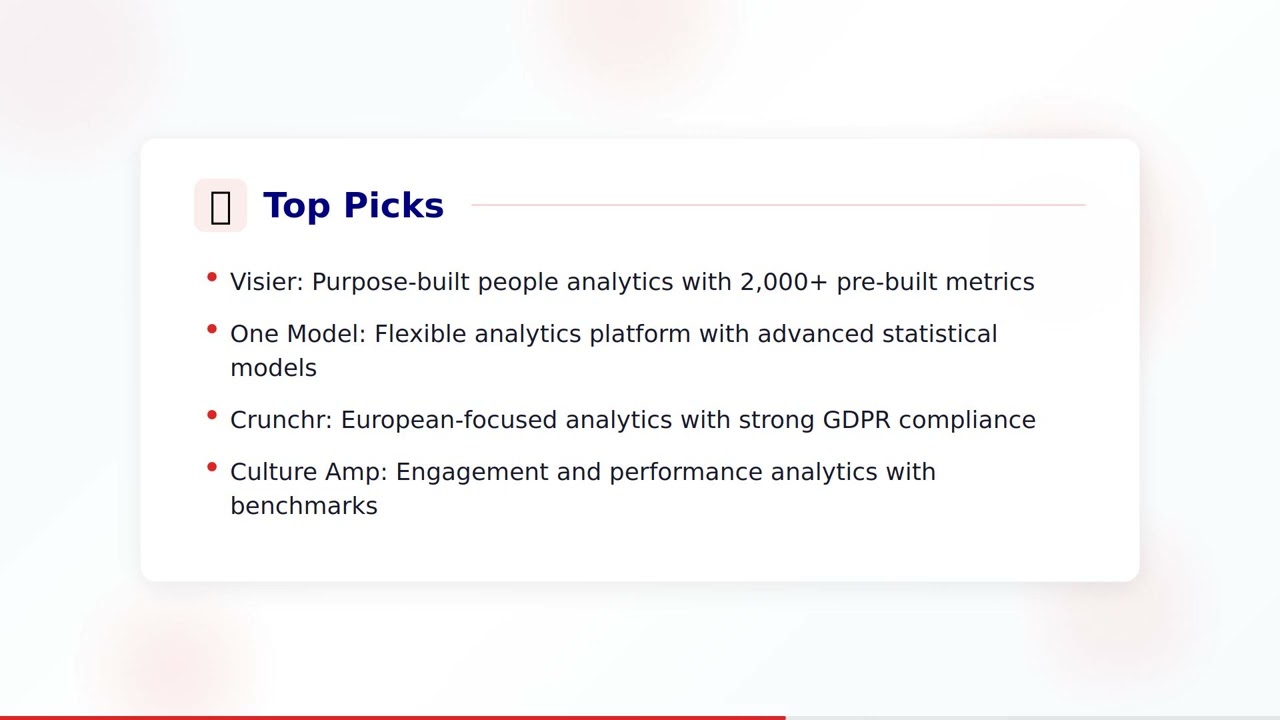
1. Visier
- People analytics platform
- Workforce planning
- Attrition prediction
- Diversity analytics
- Pre-built analytics models
- Enterprise pricing
- Complex implementation
- Requires clean data
- Steep learning curve
2. Crunchr
- Workforce planning
- Headcount analytics
- Diversity dashboards
- Attrition modeling
- Integration hub
- Newer platform
- Smaller market presence
- Limited custom reporting
- Data integration effort
3. One Model
- People data platform
- Custom analytics
- Machine learning models
- Data integration
- Storyboard reporting
- Requires analytics maturity
- Technical setup needed
- Premium pricing
- Smaller customer base
4. Lattice Analytics
- Engagement analytics
- Performance insights
- Goal tracking dashboards
- Turnover prediction
- Manager effectiveness
- Analytics tied to Lattice ecosystem
- Less depth than dedicated tools
- Requires Lattice platform
- Limited custom queries
5. BambooHR Reporting
- Standard HR reports
- Headcount tracking
- Turnover reports
- Time-off analytics
- Custom report builder
- Basic analytics compared to dedicated tools
- Limited predictive capabilities
- No advanced ML
- Fewer visualization options
6. Workday People Analytics
- Augmented analytics
- Natural language queries
- Skills intelligence
- Workforce composition
- Belonging and diversity
- Enterprise pricing
- Requires Workday HCM
- Complex implementation
- Significant admin overhead
7. Orgnostic
- Automated data aggregation
- Benchmarking
- Board-ready dashboards
- DEI analytics
- Quick setup
- Newer platform
- Limited enterprise features
- Smaller benchmarking dataset
- Fewer integrations
8. ChartHop
- Org chart analytics
- Compensation analysis
- Headcount planning
- DEI reporting
- Scenario modeling
- Primarily org chart focused
- Limited performance analytics
- Mid-market pricing
- Some features in higher tiers
9. Deel HR Analytics
- Global workforce analytics
- Compliance dashboards
- Cost analysis by country
- Contractor vs employee insights
- Payroll analytics
- Analytics newer addition
- Core strength is global payroll
- Premium pricing
- Better for distributed teams
10. Eightfold AI
- Talent intelligence platform
- Skills-based workforce planning
- Internal mobility analytics
- Diversity pipeline analytics
- Career pathing insights
- Enterprise-only
- Complex implementation
- AI-heavy approach not for all
- Significant investment
How to Select the Right HR Analytics Software
Assess Your Analytics Maturity
Before evaluating platforms, honestly assess where your organization sits on the analytics maturity curve. Organizations at the descriptive stage (basic reporting) have different needs than those ready for predictive and prescriptive analytics. If your HR data is fragmented across systems or suffers from quality issues, investing in an enterprise-grade analytics platform may be premature. Start by understanding what questions you need answered and how clean your underlying data is — this will determine whether you need a full people analytics suite or a simpler reporting tool with room to grow.
Evaluate Data Integration Capabilities
The power of people analytics comes from connecting data across multiple systems — your HRIS, ATS, LMS, engagement surveys, payroll, and even business performance data. Evaluate each platform's ability to ingest, transform, and unify data from your specific tech stack. Look for native integrations with your existing tools, API flexibility, and the platform's approach to data modeling. The best analytics tool is worthless if it can't reliably pull in the data you need. Also consider the ongoing effort required to maintain data pipelines and how the platform handles data quality issues.
Consider Self-Service vs. Analyst-Driven
Determine who will be using the analytics platform day-to-day. If you have a dedicated people analytics team, a flexible tool like One Model that supports custom queries and ML models may be ideal. If HR business partners and line managers need direct access to insights, prioritize platforms with intuitive self-service dashboards, natural language queries, and pre-built analytics like Visier or Orgnostic. The most effective implementations often balance both — providing deep analytical capabilities for specialists while offering curated, easy-to-understand dashboards for broader organizational consumption.
Prioritize Data Privacy and Security
People analytics involves some of the most sensitive data in your organization — compensation, performance ratings, demographics, and potentially health-related information. Ensure any platform you evaluate meets your data privacy requirements, including GDPR compliance, role-based access controls, data anonymization for small group sizes, and clear data retention policies. Consider where data is stored, how it's encrypted, and whether the platform supports your organization's data governance framework. This is especially critical for global organizations managing employee data across multiple jurisdictions.
Plan for Organizational Adoption
The biggest challenge with people analytics isn't technology — it's driving adoption and building a data-driven culture. Evaluate vendors based on their onboarding support, training resources, and customer success programs. Look for platforms that help you tell compelling stories with data, not just display charts. Consider how easily you can share insights with executives, embed analytics into existing workflows, and scale usage across the HR function. The right platform should make it easy for stakeholders to access relevant insights without requiring deep technical knowledge.
Current Trends in HR Analytics Technology
Generative AI and Natural Language Analytics
The integration of generative AI is transforming how HR teams interact with people data. Leading platforms now offer natural language interfaces where users can ask questions like "Why is attrition increasing in engineering?" and receive AI-generated narratives with supporting data. This democratizes analytics access, enabling HR business partners and managers to extract insights without writing queries or building dashboards, while AI assistants can proactively surface anomalies and recommend actions.
Skills-Based Workforce Intelligence
As organizations shift from job-based to skills-based talent strategies, analytics platforms are evolving to map, measure, and forecast skills across the workforce. Tools like Eightfold AI and Workday now offer AI-inferred skills taxonomies, skills gap analysis, and predictive models for skills supply and demand. This enables strategic workforce planning based on capabilities rather than headcount alone, helping organizations identify reskilling opportunities, plan for emerging skills needs, and optimize internal mobility.
Predictive Attrition and Retention Modeling
Predicting which employees are likely to leave — and understanding why — has become a core capability of modern people analytics platforms. Advanced models now combine engagement survey data, performance trends, compensation benchmarks, manager effectiveness scores, and even external labor market signals to generate flight risk scores. The best platforms go beyond prediction to prescription, recommending specific retention interventions for high-risk individuals and teams, enabling proactive rather than reactive talent management.
DEI Analytics and Pay Equity
Diversity, equity, and inclusion analytics have moved from nice-to-have to essential capability. Modern platforms offer sophisticated DEI dashboards that track representation across the employee lifecycle — from pipeline and hiring through promotion, compensation, and attrition. Pay equity analysis tools can identify statistically significant pay gaps after controlling for legitimate factors, helping organizations comply with growing pay transparency legislation while building more equitable workplaces.
Real-Time and Continuous Listening
The shift from annual engagement surveys to continuous listening is generating richer, more timely data for analytics platforms. Pulse surveys, always-on feedback channels, and passive signal analysis (email metadata, calendar patterns, collaboration tool usage) create a more dynamic picture of workforce sentiment and behavior. Analytics platforms are adapting to process these continuous data streams, offering real-time dashboards and early warning systems that alert leaders to emerging issues before they escalate.
Ethical AI and Algorithmic Transparency
As AI becomes central to people analytics, organizations are increasingly focused on ensuring ethical use of algorithms in workforce decisions. Leading platforms now provide model explainability features, bias auditing tools, and transparency reports that show how AI-driven recommendations are generated. Compliance with regulations like the EU AI Act and NYC Local Law 144 is driving vendors to build fairness testing, human oversight mechanisms, and clear documentation of how predictive models use employee data.
Frequently Asked Questions
What is HR analytics software and how does it differ from standard HR reporting?
HR analytics software (also called people analytics) goes beyond basic HR reporting by using statistical analysis, predictive modeling, and machine learning to uncover workforce insights. While standard HR reporting shows what happened (e.g., headcount, turnover rate), people analytics platforms explain why things happen and predict future trends — such as which employees are at risk of leaving, where skills gaps exist, and how workforce composition impacts business outcomes. Dedicated analytics tools typically offer data integration from multiple sources, advanced visualizations, benchmarking, and AI-powered recommendations.
How much does HR analytics software cost in 2026?
HR analytics software pricing varies significantly based on the platform tier and company size. Budget-friendly options like BambooHR Reporting and Orgnostic start at $6–12 per employee per month and offer essential reporting and dashboards. Mid-range platforms like Crunchr, ChartHop, and Deel HR Analytics typically cost $12–25 per employee per month and include predictive analytics and advanced visualizations. Enterprise solutions like Visier, Workday People Analytics, and Eightfold AI use custom pricing that often starts at $50,000+ annually, reflecting their deep analytics capabilities, dedicated support, and complex implementation requirements.
What are the most important features to look for in a people analytics platform?
The most important features depend on your analytics maturity, but key capabilities to evaluate include: (1) Data integration — the ability to pull data from your HRIS, ATS, LMS, engagement surveys, and other systems into a unified view; (2) Pre-built analytics and dashboards for common HR metrics like attrition, diversity, headcount, and compensation; (3) Predictive analytics and machine learning models for forecasting turnover, identifying flight risk, and workforce planning; (4) Self-service reporting so HR business partners and managers can explore data without relying on analysts; (5) Benchmarking against industry peers; and (6) Data security and privacy compliance, especially for handling sensitive employee data across jurisdictions.
Do I need a dedicated people analytics tool or can my HRIS handle analytics?
It depends on your organization's analytics maturity and goals. If you primarily need standard reports like headcount, turnover rates, and demographic breakdowns, your HRIS (e.g., BambooHR, Workday) likely has sufficient built-in reporting. However, if you need to combine data from multiple systems, build predictive models, perform advanced statistical analysis, or create executive-level workforce intelligence dashboards, a dedicated people analytics platform like Visier, Crunchr, or One Model will provide significantly more depth. Many organizations start with HRIS reporting and graduate to dedicated tools as their analytics maturity grows and their questions become more complex.
How long does it take to implement HR analytics software?
Implementation timelines vary widely based on the platform complexity, data readiness, and organizational scope. Lightweight tools like Orgnostic and BambooHR Reporting can be set up in 2–4 weeks with basic integrations and pre-built dashboards. Mid-range platforms like Crunchr and ChartHop typically require 6–12 weeks for data integration, dashboard configuration, and user training. Enterprise solutions like Visier, Workday People Analytics, and Eightfold AI often take 3–6 months or longer due to complex data integration across multiple systems, custom analytics model development, governance setup, and change management. The biggest factor affecting timeline is data quality — organizations with clean, well-structured HR data implement much faster than those needing significant data cleanup.
Need Help Selecting the Right HR Analytics Platform?
Our HR technology experts can provide personalized recommendations based on your organization's analytics maturity, data infrastructure, and workforce intelligence goals.