Best Succession Planning Software 2026
A detailed comparison of the top succession planning platforms to help you build leadership pipelines, identify high-potential talent, and ensure business continuity.
Watch: Succession Planning Software Guide
Comparison Criteria
Pricing
$ = Budget (Under $5/user/mo)
$$ = Mid-range ($5-15/user/mo)
$$$ = Premium ($15-25/user/mo)
$$$$ = Enterprise (Custom pricing)
User Rating
Based on verified reviews across G2, Capterra, and TrustRadius platforms. Rating out of 5.
Usability
Ease of use rating based on user interface intuitiveness, onboarding experience, and admin complexity.
Company Size
The ideal organization size where the solution performs best based on features, scalability, and pricing.
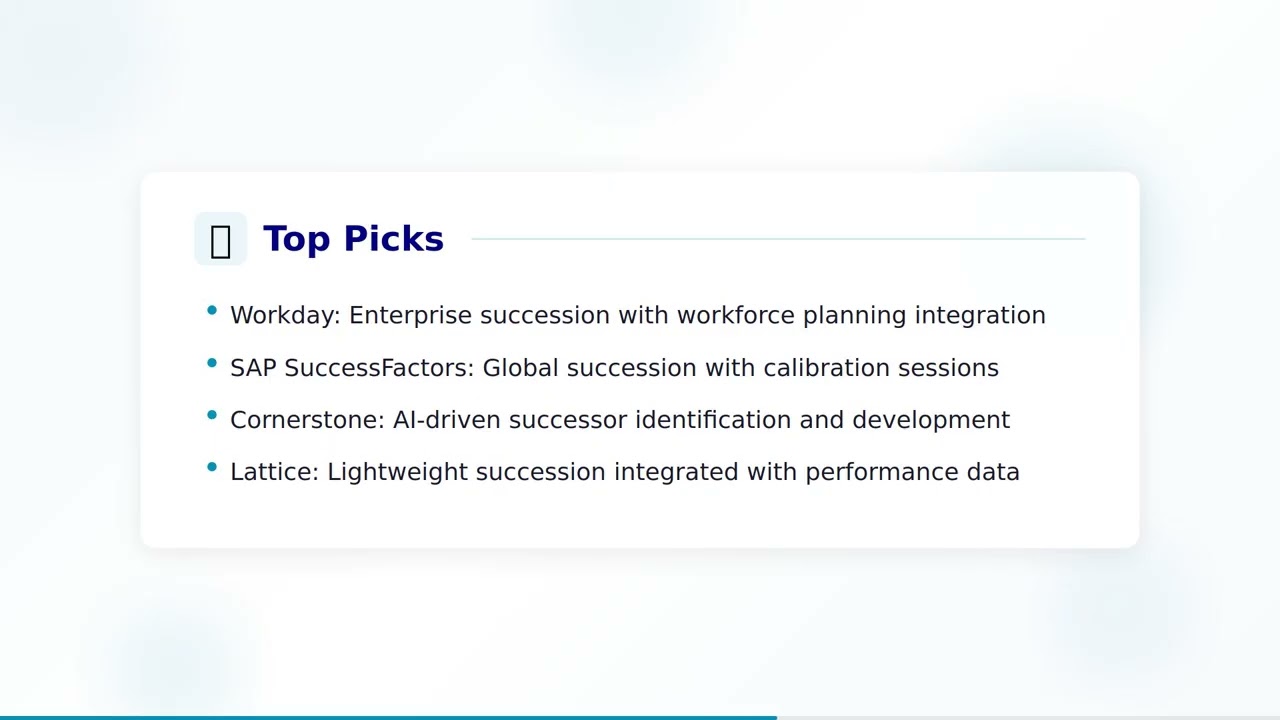
1. Lattice
- Talent reviews
- 9-box grid
- Development plans
- Career tracks
- Performance-linked succession
- Succession is add-on module
- Less depth than enterprise tools
- Requires Lattice platform
- Limited org-wide modeling
2. Workday Succession Planning
- Talent pipeline visualization
- Skills-based succession
- Readiness assessments
- Scenario modeling
- Full HCM integration
- Enterprise pricing
- Complex implementation
- Requires Workday ecosystem
- Significant admin resources
3. SAP SuccessFactors Succession
- Succession org charts
- Talent pools
- Nomination workflows
- Calibration tools
- Global compliance
- Complex implementation
- Steep learning curve
- High cost
- Requires SAP knowledge
4. Cornerstone OnDemand
- Succession planning
- Talent marketplace
- Skills graph
- Development paths
- Learning integration
- Complex UI
- Significant configuration
- Higher learning curve
- Premium pricing
5. TalentGuard
- Competency-based succession
- Career pathing
- 9-box talent review
- Skills assessments
- Workforce planning
- Smaller market presence
- Limited integrations
- Basic reporting
- Niche focus
6. Fuel50
- AI career pathing
- Internal talent marketplace
- Skills architecture
- Succession pipelines
- Engagement insights
- Premium pricing
- Implementation complexity
- Better for 500+ employees
- Limited payroll integration
7. Peoplebox
- OKR-linked succession
- 9-box calibration
- Talent reviews
- 1-on-1 integration
- Performance dashboards
- Succession features are newer
- Less mature than enterprise tools
- Limited global features
- Smaller ecosystem
8. SilkRoad (Rival)
- Talent lifecycle management
- Succession workflows
- Performance integration
- Onboarding connection
- Compliance tools
- UI could be more modern
- Smaller market share
- Limited AI capabilities
- Implementation timeline
9. Eightfold AI
- AI talent intelligence
- Skills-based succession
- Internal mobility
- Diversity pipeline
- Predictive readiness
- Enterprise-only
- Complex implementation
- Heavy AI approach
- Significant investment
10. PerformYard
- Flexible review cycles
- Goal management
- Talent reviews
- Development tracking
- Customizable workflows
- Succession features are basic
- Limited advanced modeling
- Fewer enterprise features
- Basic analytics
How to Select the Right Succession Planning Software
Define Your Succession Strategy
Before evaluating software, clarify your organization's approach to succession planning. Are you focused on executive-level succession only, or do you need a broader pipeline covering critical roles at all levels? Consider whether you want a competency-based model, a skills-based approach, or a combination. Understanding your strategy will help you identify which platforms align with your talent philosophy and long-term workforce planning goals.
Evaluate Talent Assessment Capabilities
The core of succession planning is accurately assessing talent readiness and potential. Look for platforms that offer robust 9-box grids, calibration tools, and readiness assessments that go beyond simple manager ratings. The best solutions integrate multiple data points — performance history, skills assessments, 360-degree feedback, and development progress — to create a holistic view of each employee's succession readiness and reduce bias in talent decisions.
Consider Integration with Development
Succession planning is most effective when tightly connected to employee development. Evaluate how each platform links succession pipelines to individual development plans, learning resources, and career pathing. Solutions that bridge the gap between identifying high-potential employees and actively developing them create a more actionable succession process. Native integration with your LMS or performance management system can significantly enhance this connection.
Assess Visualization and Reporting
Effective succession planning requires clear visualization of talent pipelines, bench strength, and organizational risk. Look for tools that offer interactive org charts, talent heat maps, scenario modeling, and pipeline dashboards that help leadership teams quickly understand where gaps exist. Strong reporting capabilities should also track diversity metrics in succession pipelines, ensuring your talent strategy supports equitable representation at all levels.
Plan for Scalability and Confidentiality
Succession data is among the most sensitive information in HR. Ensure your chosen platform provides granular permission controls, role-based access, and audit trails to protect confidential talent discussions and nominations. Additionally, consider how the software will scale as your organization grows — can it handle increasing numbers of critical roles, succession candidates, and global workforce considerations without significant added cost or complexity?
Current Trends in Succession Planning Technology
AI-Driven Talent Intelligence
Artificial intelligence is revolutionizing succession planning by analyzing vast amounts of workforce data to identify hidden talent, predict flight risk, and recommend development paths. Platforms like Eightfold AI and Fuel50 use machine learning to match employees to future roles based on skills adjacencies rather than traditional career ladders, enabling organizations to discover non-obvious succession candidates and build more diverse leadership pipelines.
Skills-Based Succession
Organizations are moving away from role-based succession toward skills-based models. Instead of simply identifying a replacement for a specific job title, modern platforms map the critical skills required for key positions and then identify employees across the organization who possess or are developing those skills. This approach broadens the talent pool, promotes internal mobility, and creates more agile succession frameworks that adapt as roles evolve.
Internal Talent Marketplaces
Internal talent marketplaces are transforming how organizations connect succession planning with employee career aspirations. These platforms allow employees to discover stretch assignments, project opportunities, and mentoring relationships that accelerate their development for future roles. By making succession a two-way process — where employees actively engage in their growth — organizations improve retention and build more authentic leadership pipelines.
Diversity-Focused Pipeline Building
Leading succession planning tools now include features specifically designed to improve diversity in leadership pipelines. This includes blind talent reviews, diversity scorecards for succession slates, bias detection in readiness assessments, and analytics that track representation across succession tiers. These capabilities help organizations move beyond good intentions to measurable progress in building equitable leadership teams.
Scenario Planning and Risk Modeling
Advanced succession tools now offer scenario modeling capabilities that allow HR leaders and executives to simulate various workforce changes — such as key leader departures, organizational restructuring, or rapid growth — and assess their impact on talent readiness. These features help organizations proactively prepare for multiple futures rather than reactively scrambling when transitions occur, making succession planning a truly strategic business function.
Continuous Succession Reviews
The traditional once-a-year succession review is giving way to continuous talent monitoring. Modern platforms provide real-time dashboards that update as employees complete development milestones, change roles, or receive new performance data. This continuous approach ensures succession plans stay current and actionable, rather than becoming outdated documents that sit on a shelf between annual talent review cycles.
Frequently Asked Questions
What is succession planning software and why do organizations need it?
Succession planning software is a specialized HR technology tool that helps organizations identify, develop, and prepare high-potential employees for critical leadership and key roles. It provides features like 9-box talent grids, readiness assessments, talent pipelines, and development tracking. Organizations need it to reduce leadership gaps, ensure business continuity during transitions, retain top talent by showing clear career paths, and make data-driven decisions about their talent pipeline rather than relying on subjective judgments.
How does a 9-box grid work in succession planning tools?
A 9-box grid is a talent assessment matrix that plots employees on two axes: current performance (low, moderate, high) and future potential (low, moderate, high). This creates nine categories ranging from 'low performer / low potential' to 'high performer / high potential' (often called stars or top talent). Succession planning software automates this process by pulling performance data, manager assessments, and skills evaluations to place employees in the grid, helping HR leaders identify who is ready for promotion, who needs development, and who may be at risk of leaving.
What is the difference between succession planning and replacement planning?
Replacement planning is a reactive approach that simply identifies backup candidates for specific roles — it answers 'who will fill this seat if someone leaves?' Succession planning is a proactive, strategic process that builds a pipeline of talent across the organization by developing skills, creating career paths, and assessing readiness over time. Modern succession planning software supports the strategic approach by integrating career development, skills gap analysis, and long-term workforce planning rather than just maintaining a list of potential replacements.
How much does succession planning software typically cost?
Succession planning software costs vary widely based on the vendor and organization size. Budget-friendly options for small to mid-size businesses typically range from $5–15 per user per month (platforms like Lattice, Peoplebox, or PerformYard). Mid-range solutions run $15–25 per user per month (such as Cornerstone OnDemand or Fuel50). Enterprise platforms like Workday, SAP SuccessFactors, and Eightfold AI use custom pricing that can be significantly higher but include comprehensive HCM integration. Many vendors also charge implementation fees, so factor in total cost of ownership when comparing.
Can succession planning software integrate with existing HR systems?
Yes, most modern succession planning software offers integrations with popular HRIS, payroll, performance management, and learning management systems. Enterprise platforms like Workday and SAP SuccessFactors include succession planning as part of their broader HCM suite, providing native integration. Standalone tools like Lattice, Fuel50, and Peoplebox typically offer API connections and pre-built integrations with systems like BambooHR, ADP, Workday, and Slack. When evaluating vendors, check for native integrations with your existing tech stack to avoid custom development costs and data silos.
Need Help Selecting the Right Succession Planning Software?
Our HR technology experts can provide personalized recommendations based on your organization's succession strategy, talent pipeline goals, and leadership development requirements.